Export & no lock-in
Your workshops are yours — completely and at any time. This page shows how to get your content back out of flow present.
Our stance: no lock-in
Section titled “Our stance: no lock-in”We don’t believe in lock-in effects. A tool that keeps its users only through high exit barriers doesn’t have a good product — it has built a trap. We’re convinced that flow present stands on its own merits. The best proof is that you can leave at any time and take your work with you in full. That’s exactly why an easy exit isn’t a contradiction to signing up — it’s the invitation to.
Where to export
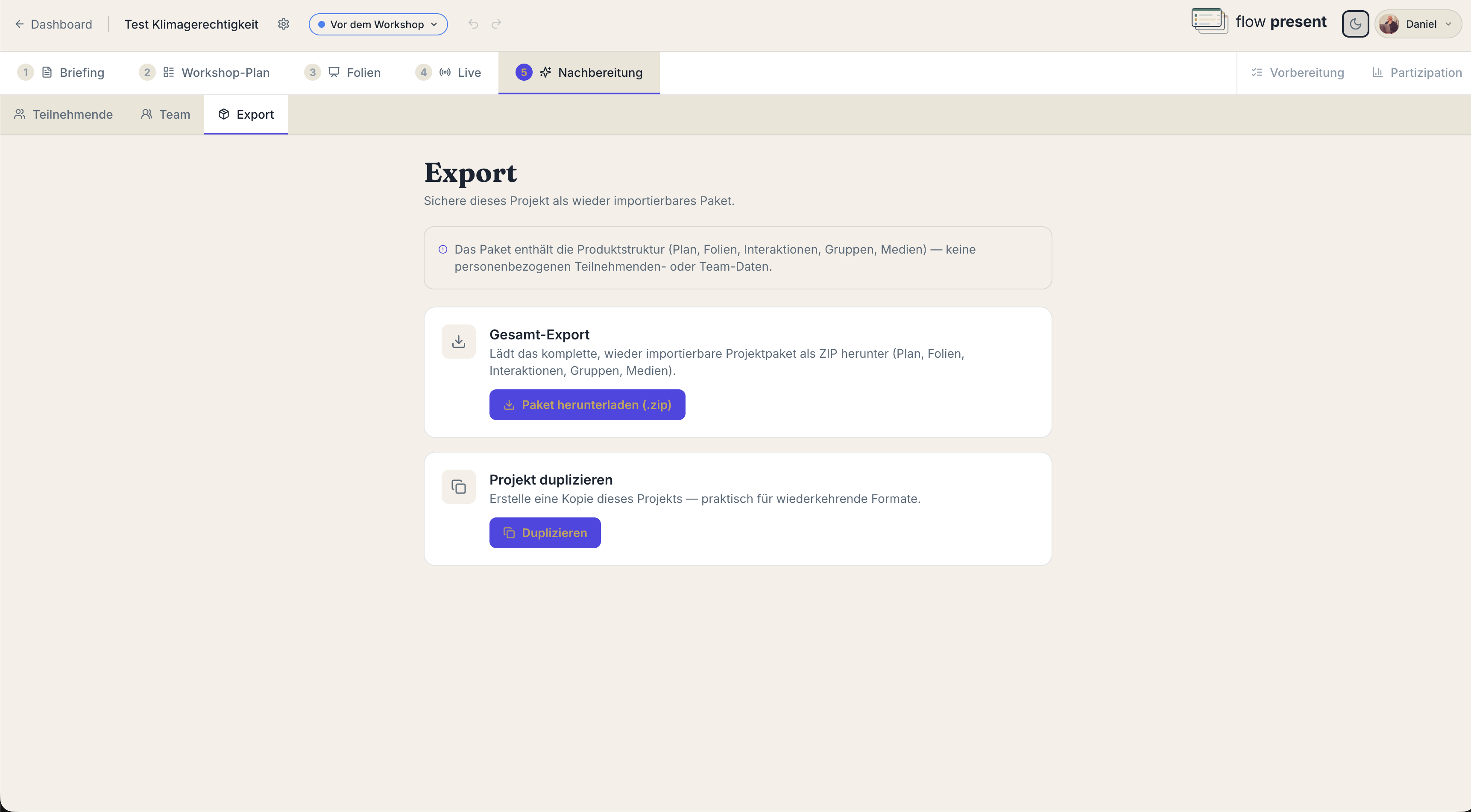
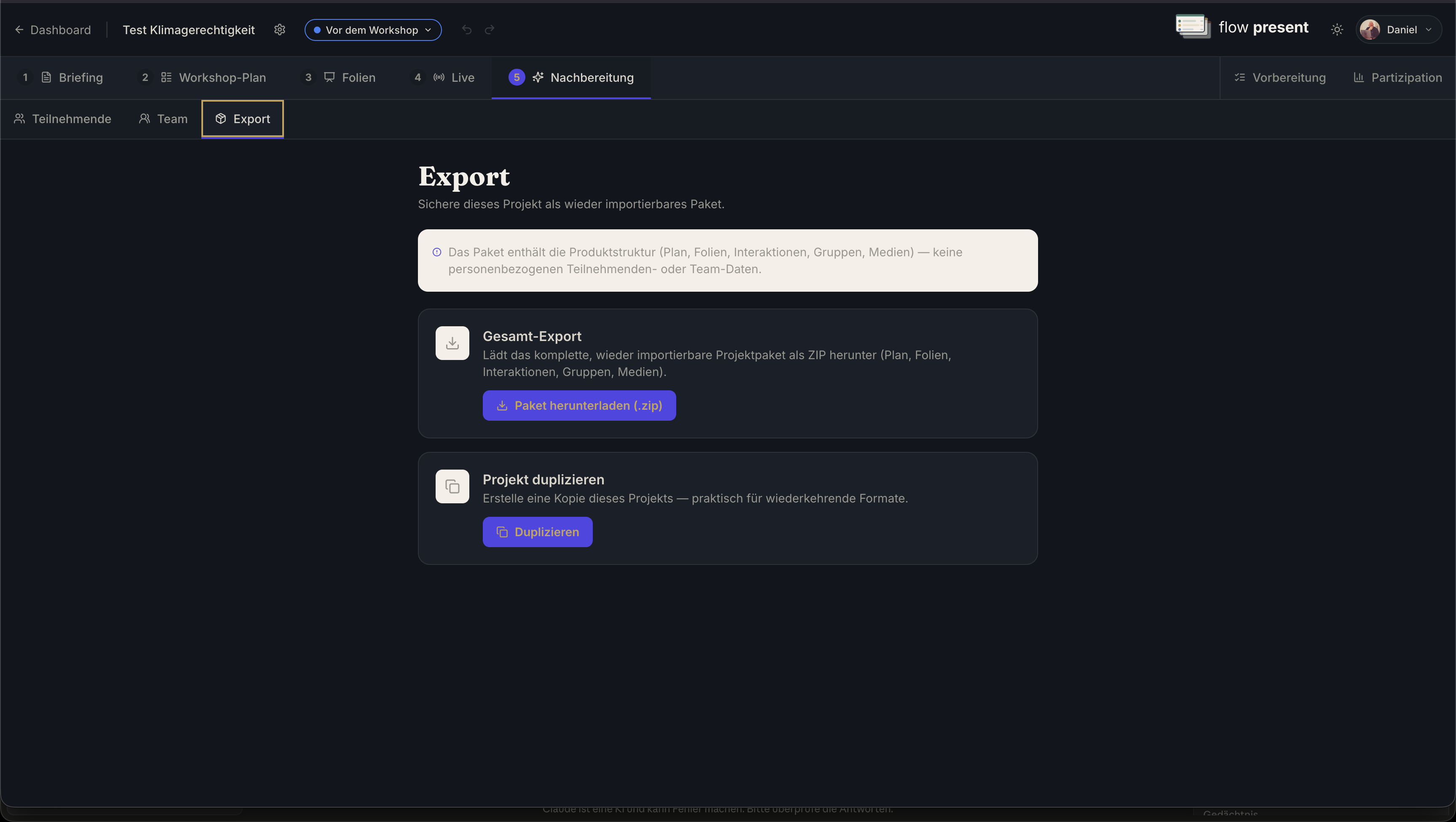
Section titled “Where to export”You’ll find the export in the Follow-up phase, in the Export tab. The area works the same in every project — in both light and dark mode.
Three levels of export
Section titled “Three levels of export”1. The complete workshop package Available
Section titled “1. The complete workshop package ”The full export downloads your entire project as a re-importable package (.zip) — with the
plan, slides, interactions, groups, and media. With it you can move your workshop to another or
your own self-hosted flow present instance: download the package, import it there, keep working.
Because flow present is open source at its core,
you own not just the content but also the means to keep running it without us.
Right next to it you’ll find Duplicate project — a quick copy within flow present, handy for recurring formats.
2. Slides as a standalone reveal.js package Coming soon
Section titled “2. Slides as a standalone reveal.js package ”Behind the slides part of flow present is reveal.js, the well-established open-source presentation engine. We’re working on an export that outputs your entire slide set as a standalone, runnable reveal.js package. The benefit is twofold: it’s your fallback in case the network wobbles at the venue — and it lets you move on with all your decks, entirely without flow present.
Already available for the offline case: the slides PDF export (Preparation → “Just before the workshop”), which reveal.js lays out cleanly for printing. The full interactive reveal.js package will follow shortly.
3. Open knowledge export (OKF) Coming soon
Section titled “3. Open knowledge export (OKF) ”A workshop is a structured body of knowledge. That’s why we’re adopting the Open Knowledge Format (OKF) — an open format introduced by Google Cloud that stores knowledge as plain Markdown files: readable by humans and optimized for AI agents at the same time, without proprietary systems or vendor lock-in. The goal: high interoperability, regardless of which tools (or LLMs) you work with next.
We already use the format internally; an export of your workshop content as an OKF bundle is coming shortly — so you can reuse your workshop knowledge openly and tool-independently, for example as context for your own AI agents.
Your data stays yours
Section titled “Your data stays yours”For us, no lock-in isn’t a marketing promise — it’s built in: open formats, an open-source core, and an export that lets you take what’s yours. For more on where your data is stored and how to delete it, see Privacy, security & law. To share or embed slides and the live view, see Share & embed.